
This post was written in collaboration with Hassan El Tabch.

When it comes to close reading, we all have our struggles in interpreting texts and diving deep in understanding their meaning. It becomes more strenuous when there are several texts that belong to an author to analyze. Nowadays, thanks to the development of digital technology in the human sciences, distant reading enables us to inspect a corpus, which is a collection of literary texts, without having to read the actual thing. Distant reading identifies recurring patterns, through computer softwares that can analyze hundreds of texts(called ‘data-mining’) and generates schematic representations on the number of times particular words appeared over the course of a corpus. Throughout this blog, we will be using two famous tools to read from afar, CLiC and Voyant Tools.
CLiC, which stands for Corpus Linguistics in Context, is a corpus tool that can be used to study literary texts,and to make connections between patterns of languages across genres by searching for a word/phrase(s) across a text or a set of novels.On CLiC, we can access four corpora: Dickens’s Novels, 19th Century Reference Corpus, 19th Century Children’s Literature Corpus and additional requested texts(books that users requested to add). For this blog, we have chosen The Sign of the Four by Arthur Conan Doyle as a case study. The first questions that came to our mind, and to which we think CLiC would help us to answer were :
- Does the title indicate anything about the book?
- What is the main theme of the book?
- What are the most relevant frequent words in the book?
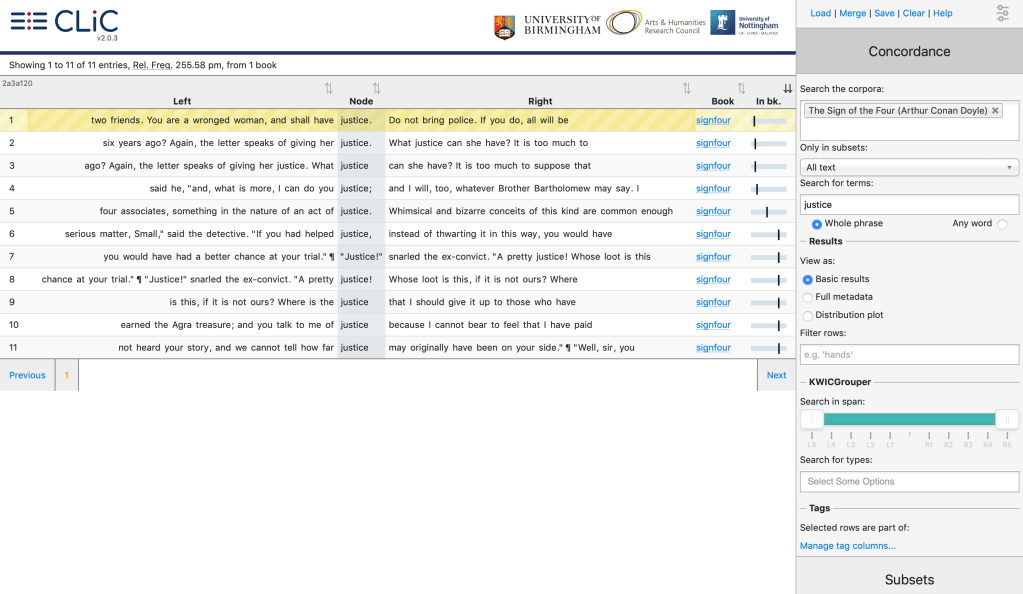
We started by navigating to the Concordance tab, which reveals the context in which a particular word occurs, then in the ‘Search for Corpora’ box, we inserted the targeted book The Sign of the Four, followed by the selection of All text in the ‘Only in Subsets’ section and typing the word the sign of the four under ‘Search for terms’. As a result, the sign of the four is mentioned 7 times. We got more intrigued to find out what significance it holds so we discovered a new feature in CLiC: by clicking on the ‘In bk’ on the right hand side, it opens the line where the term actually occurred in the book. After digging in, which we had to do through close reading, it turned out that the ‘four’ in the title symbolizes four criminals in the story: Jonathan Small, Mahomet Singh, Abdullah Khan and Dost Akbar. As we dug deeper, we noticed that these characters always left a signature note in the scenes that they have been in, written in a careless way as it was associated with the adjectives “very rough” and “coarse” and said it was “scrawled” to reflect the horror atmosphere that surrounded the crime scenes.
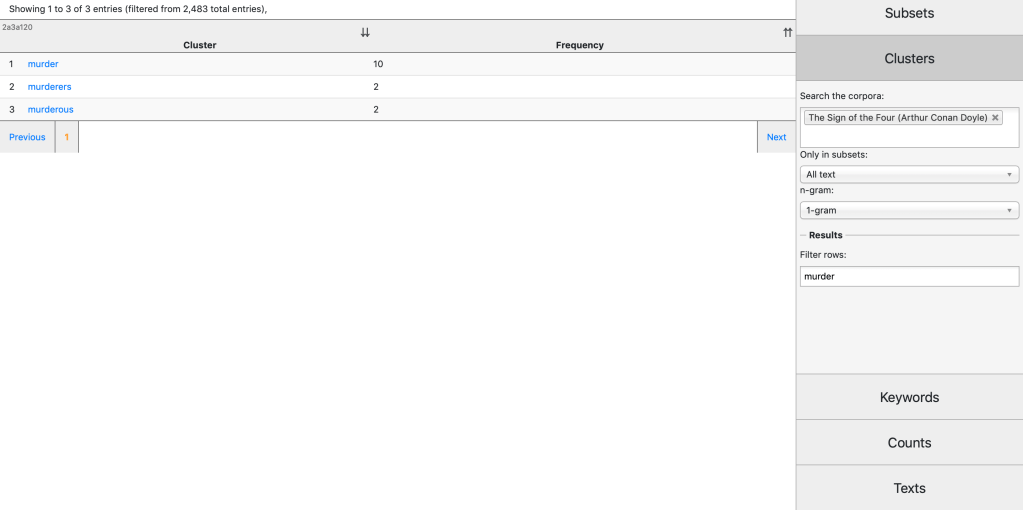
Afterwards, we repeated the same steps several times, but chose different terms such as justice, fear, crime and treasure. First, justice was mentioned 11 times, in the following expressions: “shall have justice”, “giving her justice”, “I can do you justice”, ” an act of justice” and more, which indicates that one of the main themes in the novel is seeking justice on behalf of Mrs Mary Morstan. Second, fear also occurred 11 times, and was preceded by “ecstasy [of fear]”, “with [fear] “ ,” I [fear]”, “brought”, etc… showing the atmosphere of terror that surrounded the events of the novel. As much of the novel happened during night-time where murder and crimes occurred, feelings of fear were dominating in the novel. The term treasure stands out as it appeared 67 times, the most out of the searched terms, and was associated with verbs indicating that it was lost and was being searched for, such as “find”,” [the treasure] is gone”, “buried”,”is lost” , etc… The treasure was called ‘Agra’ and a share belonged to Mrs Morstan. Crime also appeared 8 times. Hence, the main themes covered in Conan’s The Sign of the Four were justice, evil and a treasure hunt, as it is actually a detective story. To dig in further, we went to the CLiC ‘Cluster’ tab, which indicates repeated sequences of words in a corpus, then selected 1-gram in the ‘n-gram’ box and noticed that holmes is repeated for 126 times, as it turned out to be the name of the main character, detective Sherlock Holmes, which justifies its high frequency. Finally, also in the ‘Cluster’ tab, we selected 1-gram and searched for murder in the ‘filter rows’ box: murder appeared 10 times, murderers 2 times and murderous 2 times which reflects the crime theme.
On the other hand, Voyant tools, which I personally prefer over CLiC, is a web-based text reading and analysis application. It offers a certain level of freedom as you can upload the desired collection of texts in various formats (plain text, HTML, PDF, MS Word…). Voyant is an important tool in digital humanities that can supplement close reading by doing data mining to discover meaningful patterns, as their tag-line says, “see through your text”.
We continue to study the works of the British author Arthur Conan Doyle on Voyant tools by extracting the following novels from The Gutenberg Project, an online library with over 60,000 free ebooks:
- A Study in Scarlet (1887)
- The Sign of the Four (1890)
- The Adventures of Sherlock Holmes (1892)
- The Valley of Fear (1915)
- His Last Bow (1917)
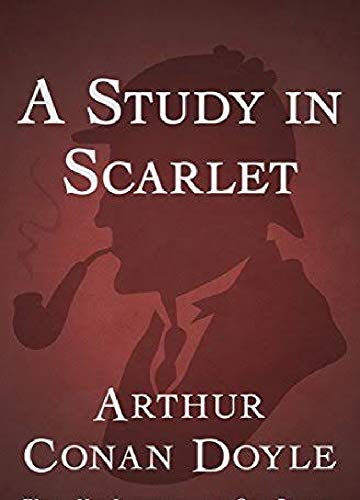
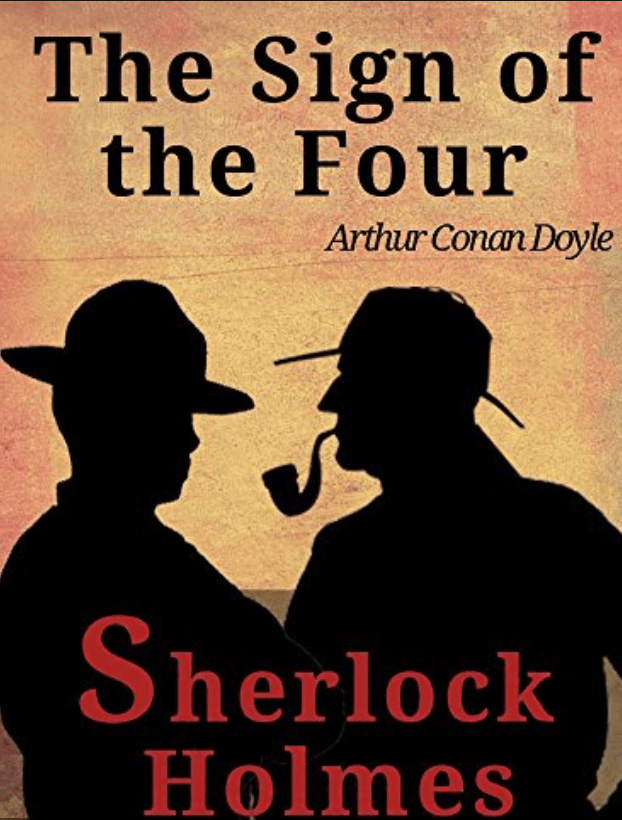
We chose to analyze these novels as they revolve around the infamous detective Sherlock Holmes, for which many of his stories were transformed into visual productions (movies/series). We wanted to explore Doyle’s style of writing and study how the era in which he lived affected his genre.
After downloading Doyle’s work in plain text versions so that Voyant tools can process them easily, we made sure to name the files in the following format : [Year] [Title], which enables VT to order them chronologically. The first research question revolved around the main themes in Doyle’s novels. However, this question couldn’t be answered by simply inspecting the frequency of word occurence, so we had to modify the question to focus on gender representations. In addition, we thought that the Voyant tool would be helpful to find how Doyle’s writing style evolved.
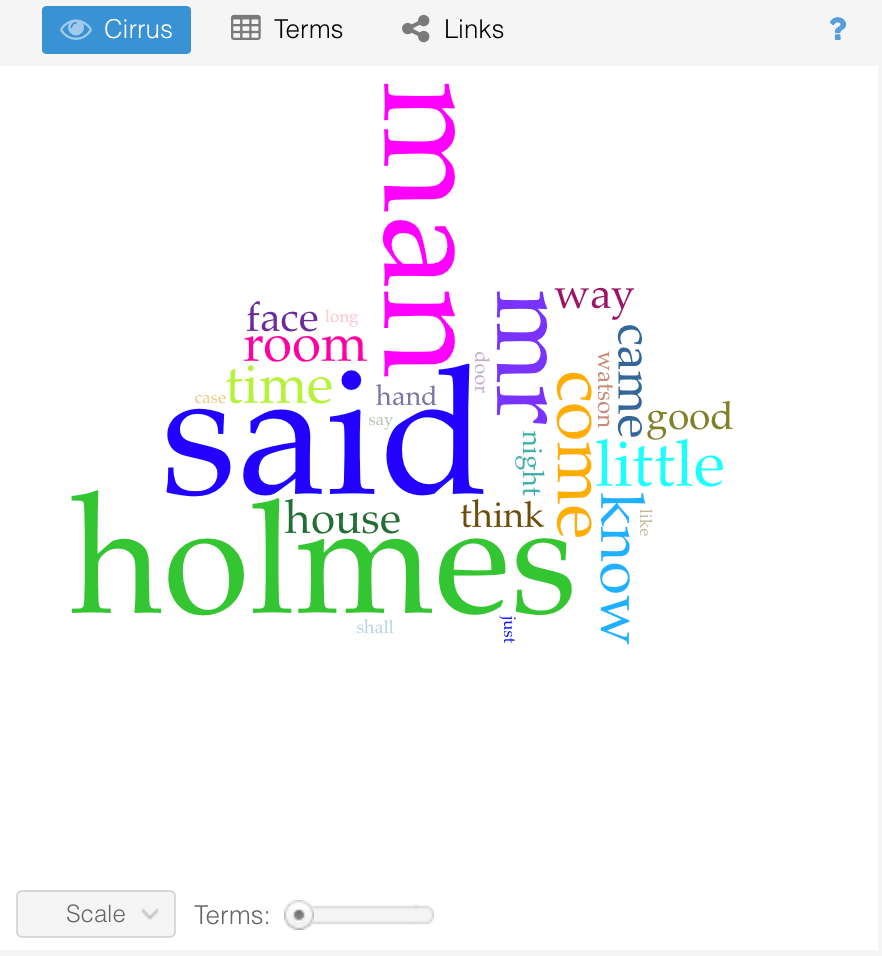
We started by inspecting the Cirrus section, a word cloud that visualizes the top frequency words of a corpus by placing the most frequent words in the center complemented by a large font size. The initial insight we got ,after modifying the number of terms to 25, was the dominance of the words Holmes, justified by the novels being centered around the detective Sherlock Holmes. In addition, the occurrence of terms referring to men was noticeably high as they were also visualized in large size.
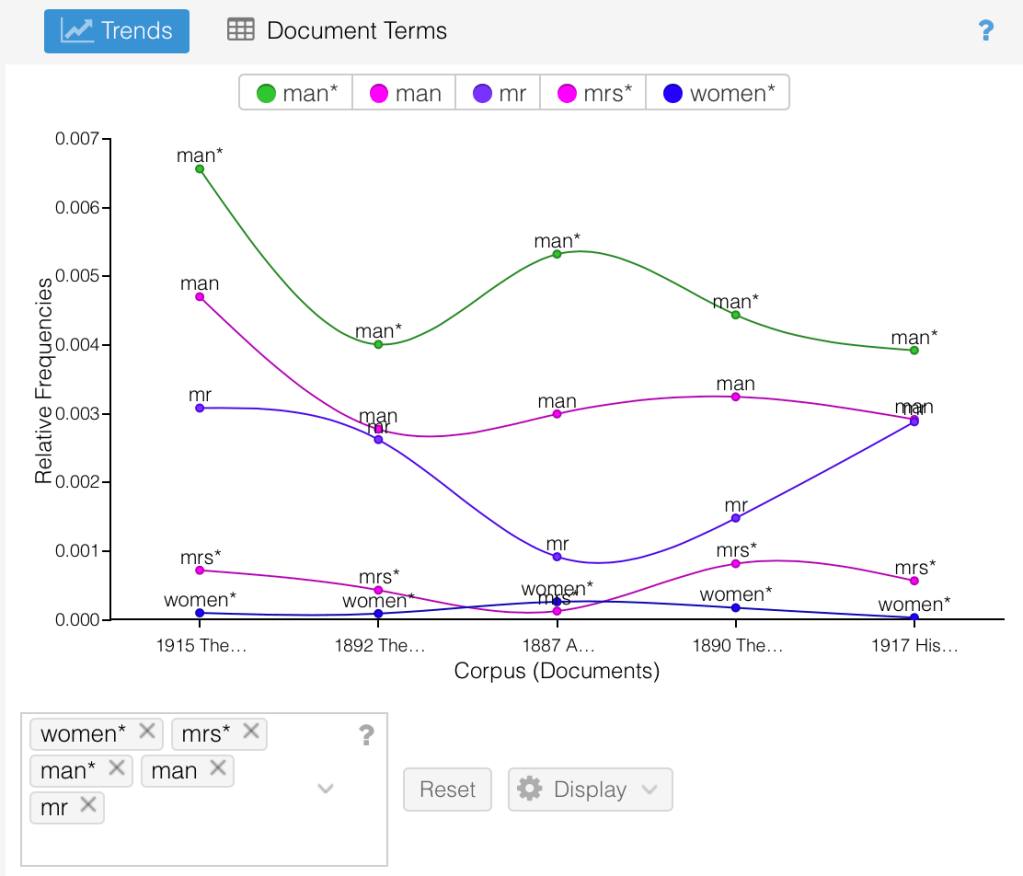
To begin with, we wanted to visualize the frequencies of terms across our corpus that were relevant to gender. In the trends section, we added man, mr, mrs and woman. The results showed the dominance of the masculine gender over the feminine. This trend indicated the domination of male characters in Doyle’s literary texts, as the situation was in the Victorian Era where the crime fiction genre was increasingly masculinized and the role of women was limited.
Furthermore, Voyant tool has a Summary section where it provides a textual overview of our corpus. This tool allows us to study Doyle’s writing style, by inspecting The Length of the texts, Vocabulary Density and average Number of Words per Sentence.
A Study in Scarlet, published in 1887, had the highest vocabulary density of 0.132, followed by The Sign of the Four (1890), then The Adventures of Sherlock Holmes (1892) and finally The Valley of Fear (1915). We also noticed that the average words per sentence decreased as he released more of his works. This shows how Doyle’s writing style was richer in terms of vocabulary in his earlier releases and how he shortened his sentences as he wrote more novels.
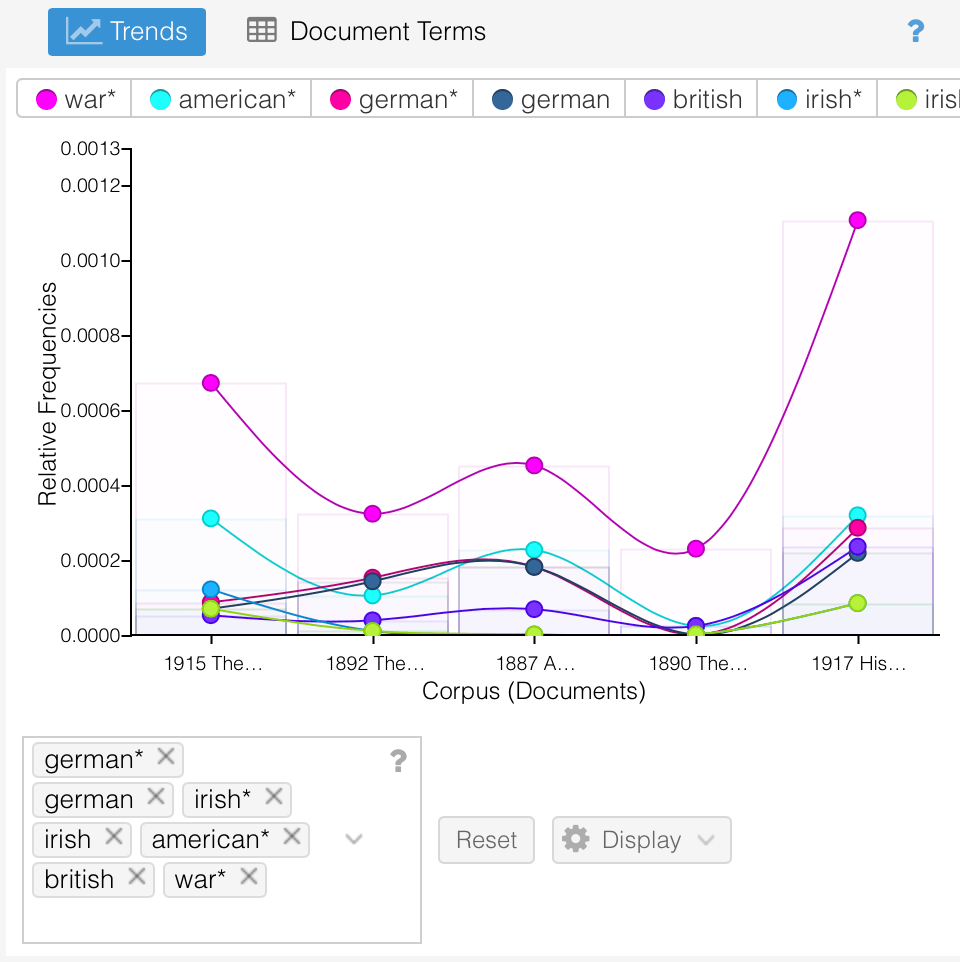
Since His Last Bow was published in 1917, at that time where the First World War was still being fought, we decided to inspect if the political events had affected Doyle’s writing. We examined the trends of the following terms: war, British, American, Irish and German. Indeed, the use of these terms peaked in his novel His Last Bow, which reflects the effect of the political events on his writing. In addition, upon doing some close reading on the novel, it turned out that Doyle changed his style by narrating the story in the third person, contrary to the usual first person narrator in his previous works, with the story revolving around a spy-story reflecting patriotic and nationalistic themes.
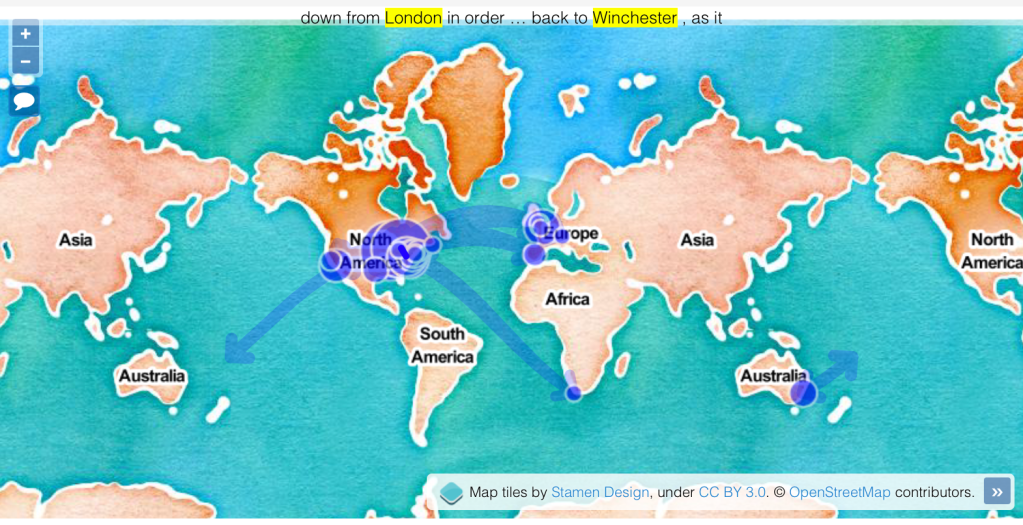
In addition, Arthur Conan Doyle was a frequent traveler who visited a handful of countries such as The Arctic, West Africa, Australia and toured around Europe. In 1894, Doyle visited the US and Canada for a lecturing tour. Voyant’s DreamScape allowed us to justify the different references to European countries,and countries Doyle has visited in his novels. However, DreamScape produces a significant number of errors by mistakenly tagging locations that aren’t actually locations or the other way around. Consequently, we resorted to close reading to identify if Doyle was mentioning the countries/cities he’s been visiting using the view occurrences tool that allows us to examine the location more precisely. Our findings confirmed that Doyle mentioned several cities and countries that he had visited during his lifetime in his novels.
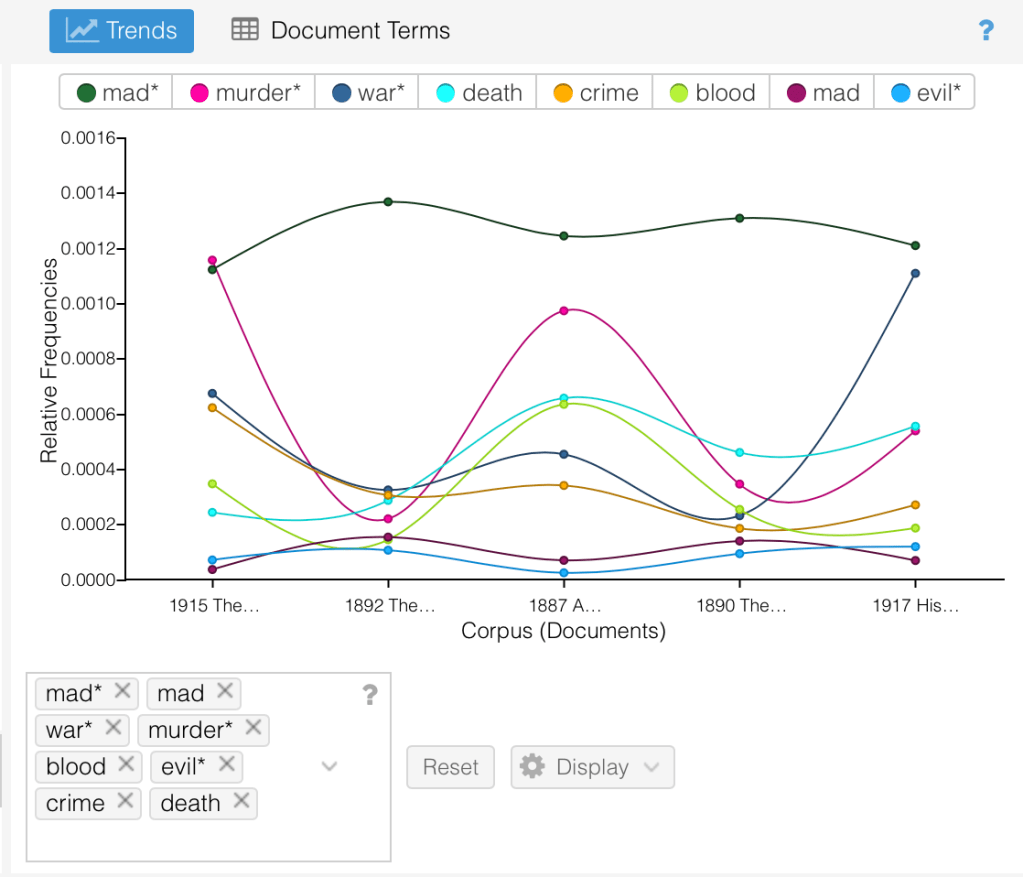
Finally, we searched for the terms death,crime,evil,blood, murder,war and mad. Their occurrence was frequent obviously as our corpus main genre was crime fiction, adding to that that two novels were published by the time the First World War started which backs the violence in Doyle’s novels
To wrap things up, we found that VT and CLiC,two distant reading tools, were essential for us to conduct research in the Digital Humanities field. Given it is our first experience with these tools, they are straight-forward and user-friendly backed up by a tutorial page that provides detailed help. VT is more flexible than CLiC as any digitized corpus can be uploaded for textual analysis. As for our personal opinion, We prefer VT as it provides more options for statistical analysis, and presents the results in many forms and colors which makes the platform more practical.

In conclusion, Distant reading tools allow us to see the bigger picture and enables us to study and perform textual analysis of hundreds and even thousands of texts; something that cannot be done through close reading as it would take ages. In addition, Distant reading aids us in discovering new connections between literary texts and facilitates the reading process. However, there are several limitations that prevent us from solely relying on distant reading. First, we would loose the ‘sensory experience’ of holding a book and reading it. In addition, several details can only be discovered through close reading. Regarding the matter of subjectivity, each reader percepts the text in his own opinion, contrary to computer softwares that deal with this matter with utter objectivity. All in all, the combination of both close and distant reading can help us analyze literary texts and improve the quality of our research.
 Ali's Blog