
This blog was written in collaboration with Hassan El-Tabch

Icon made by Vitaly Gorbachev from www.flaticon.com
With the current pandemic that left the whole world on lockdown, the Introduction to Digital Humanities course (ENGL256B) was the perfect choice to keep us busy at home. Engaging in emerging digital tools to conduct research and build our project was the highlight of our semester. Our final project explores the world of Thomas Hardy, one of the most renowned poets and novelist in English literature. Hardy’s works are still studied and celebrated to this day with many of his novels transformed into movies. Hardy was caught on our radar when we were considering our choices for our final project as he was known for his fearless criticism of the social norms and cultural beliefs in the Victorian age. Moreover, we were interested in the theme of nature and its creatures where Hardy’s depiction of the green sceneries and its animals in his distinctive writing style sparked a sense of curiosity in us to dig deeper in his works through the lens of the DH (digital humanities) tools that we’ve come across, to unravel unseen insights on his work.
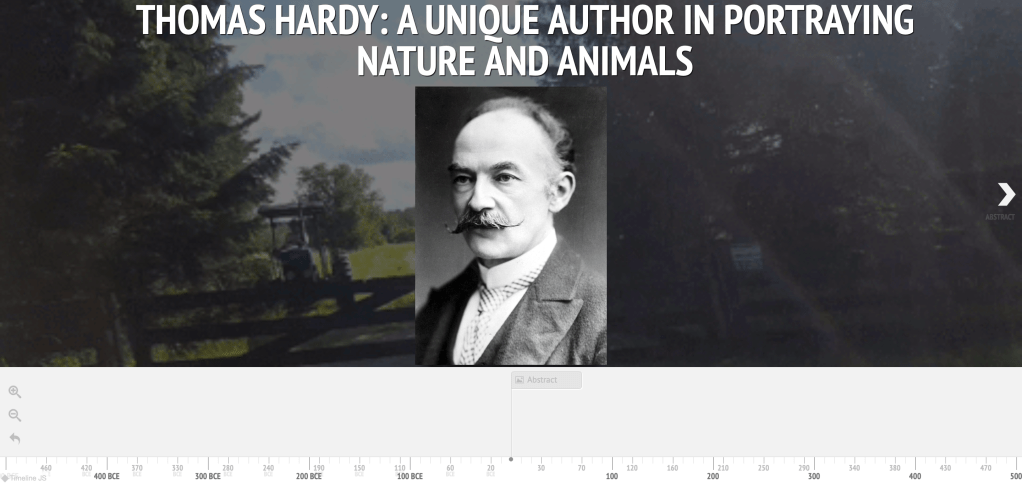
Before starting to work on our final project, our research question had a broad aspect as they were mainly about the main themes in Hardy’s novels and the impact of his life experiences on his writings. However, as we were introduced to more DH tools, we were able to narrow our research focus and shed light on meaningful and distinctive insights. Hence, our focus shifted towards the distinctive portrayal of nature, the pessimistic view of time, the criticism of gender inequalities in Hardy’s society and finally the influence of his life events on his works.
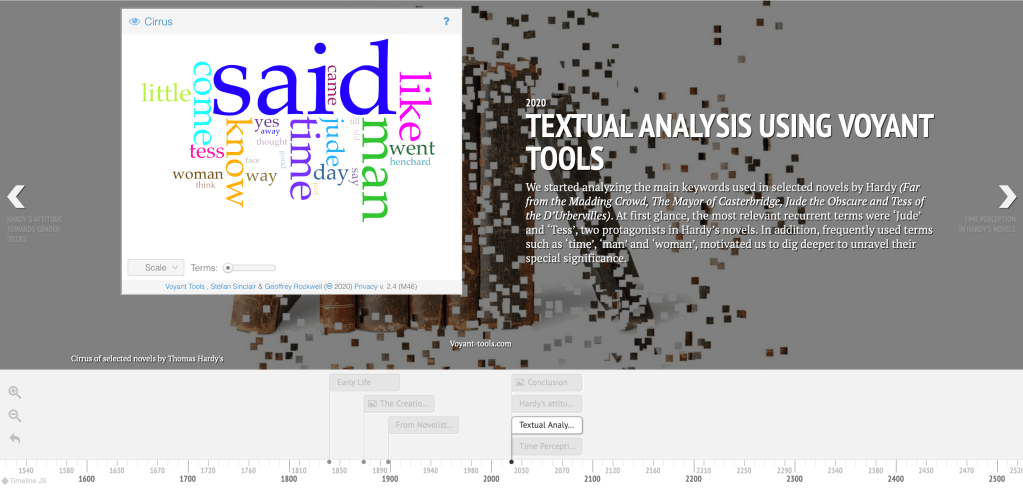
Using Voyant tools, we analyzed arguably Hardy’s finest works: Far from the Madding Crowd (1874), The Mayor of Casterbridge (1886),Tess D’Urbervilles(1891) and Jude the Obscure (1895). At first, we were able to analyze the significance of the word ‘time’, given its high frequency in Hardy’s four novels. By inspecting through close reading the context section in VT, Hardy attributed a pessimistic view towards time. He portrays man as a doomed creature, with time acting as a force working against man’s efforts to control his own destiny and by also portraying it as an unpredictable element of nature that causes suffering to humans.
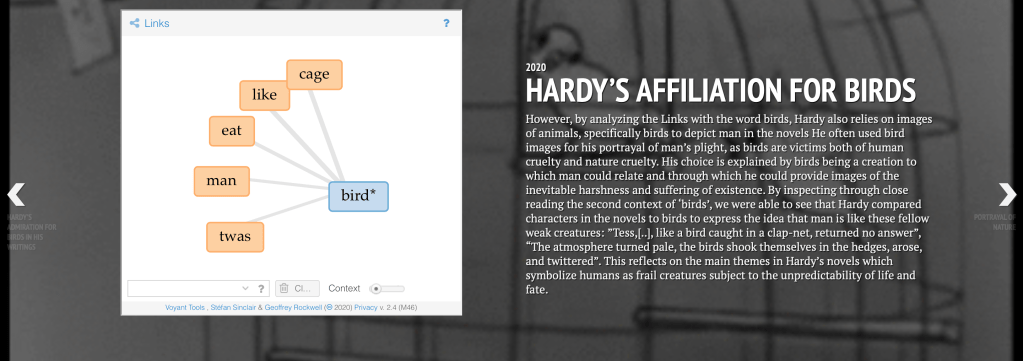
Furthermore, VT allowed us to explore Hardy’s distinctive portrayal of nature and bird imagery in his works. To begin with, Hardy’s four novels are rich in landscape description that helped him paint an image of delight, peace and sadness in the reader’s mind. His distinctive writing style showed us his depiction of the green sceneries to be full of sound, movement and colors. Moreover, bird imagery in Hardy’s corpus was used to display clashing aspects: life, joy and suffering. Hardy used bird imagery to paint an image of the natural world full of beauty and hope. He also emphasizes on the importance of treating animals and especially birds with care and kindness, which unraveled the soft, caring side of Thomas Hardy. On the other hand, Hardy uses birds to mirror the image of man’s plight in life. As birds are victims both of human and nature cruelty, Hardy found them as creatures whom man can relate too, to paint images of the inevitable harshness and suffering of existence. This illustrates one of the main themes in Hardy’s novels which symbolizes humans as frail creatures subject to the unpredictability of life and fate.
Voyant Tools allowed us to group Hardy’s selected novels and perform thorough textual analysis on them. VT outlined the words that have the highest occurrence in the corpus to draw the bigger picture, and by navigating to the Contextsection and switching to close reading, we dug deeper to find associations between the terms used and Hardy’s vision and writing style. Voyant tools played a crucial role in our project as it was one of the building stones of our analysis that allowed us to shed light on unseen links in Hardy’s novels regarding his love for animals, his pessimistic view of time and his admiration for nature.
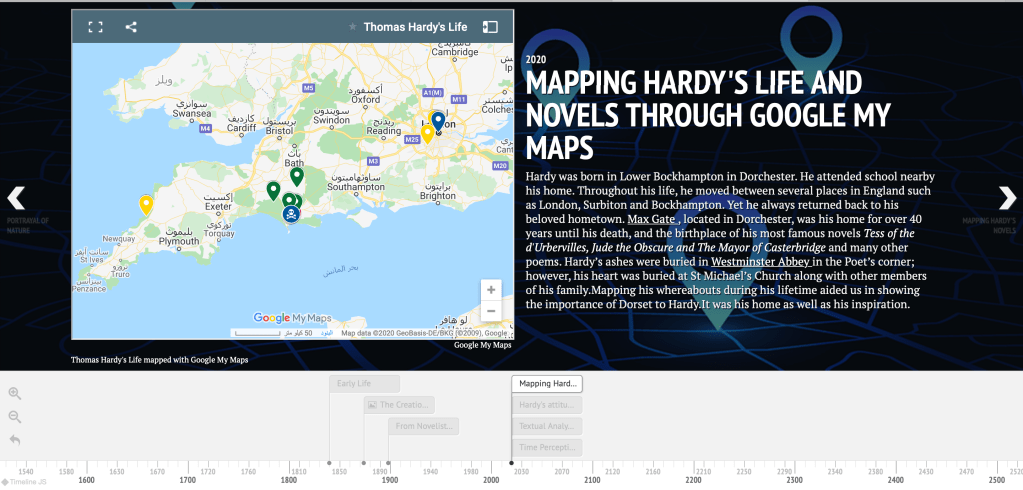
Mapping Hardy’s novels Google My Maps aided us in getting a clearer view of the relationship between events in hisnovels and his life by making connections between locations. By pinpointing relevant locations,we were able to unravel unseen relationships in the author’s choice of locations.Hardy built, through his writings, the image of a fictitious land called Wessex. The majority of the event of the novels depicted in this Wessex. By comparing the maps of Far from the Madding Crowdand Tess D’Urbervillesto his life map, we clearly saw the harmony between them. As Hardy spent most of his lifetime in his hometown, Dorset, he was inspired by the green landscape and animals that surrounded him and hence the excessive portrayal of nature and animals in his works. Moreover, Hardy’s birthplace and burial location are really close, which indicated the unconditional love he had for his hometown and further affirms the impact it had on his writings. However, Thomas Hardy’s mind wasn’t limited to Dorset, as the mapping of Far from the Madding Crowd unfolded a wandering mind that mentions historical events in his novels (Check Paragraph 4 in Blog 3). These insights enabled us to witness his unique writing style.All in all, the mapping process revealed the impact of Dorset on Hardy’s writing, something we didn’t not acknowledge before. Google My Maps was a necessary tool to conduct the comparisons between the author’s location and the setting he chose for his novels.
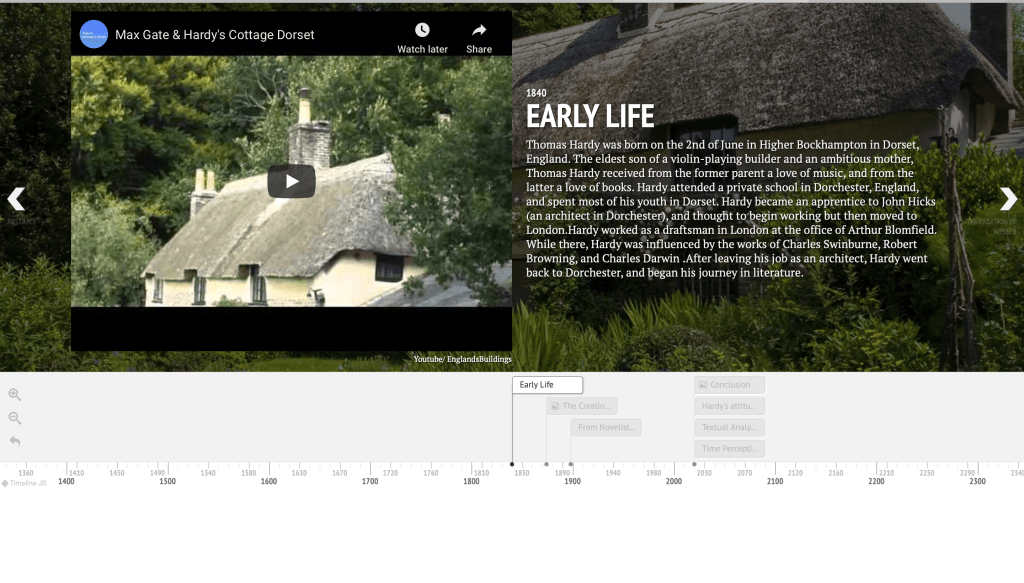
As we gathered all the analysis of our project, TimelineJS was the final piece to aesthetically present our findings.The chronological arrangement of entries emphasizedthe time relations between the author and his literary works, which aided us to shed the light on unseen connectionsbetween his life and his novels. We started by introducing Thomas Hardy to give the reader an idea about the author and his uprising to novelist/poet, then presented our analysis. In addition, adding multimedia such as colored backgrounds, GIFs, embedded media and also embedding the DH tools used allows the reader to interact with the timeline and become more involved in the author’s life and works.
As a conclusion, this project has been an eye-opener towards the literary works of Thomas Hardy in addition to his personal life. The different DH tools that we came across in the virtual classroom were very helpful and valuable to achieve our goals in terms of research and new insights about the author. Our experience in the course, although disrupted by the pandemic, was fruitful as these DH tools proved to be very beneficial and important to unravel unseen links and explore the author’s life and novels. Make sure to check out our project and subscribe to our blog to stay updated on our journey in future academic courses!
 Ali's Blog